About Us
Medical Research and Analysis (MRA) is a knowledge-driven academic platform committed to strengthening scholarship and informed discourse in the fields of medicine, healthcare, and life sciences. It serves as a credible and inclusive space where rigorous research, critical analysis, and continuous education come together to support students, researchers, and professionals at various stages of their careers. MRA is dedicated to nurturing a culture of evidence-based learning that encourages intellectual curiosity, scientific integrity, and practical relevance.
At the core of MRA’s mission is the promotion of high-quality, ethically sound, and impactful knowledge that contributes meaningfully to the evolving landscape of healthcare and medical innovation. The platform facilitates skill development through carefully designed short courses, research-oriented resources, and analytical content that address contemporary challenges in medicine and public health. By offering insightful articles, scholarly commentary, and applied learning modules, MRA enables learners to translate academic research into real-world practice.
MRA also aims to bridge the longstanding gap between theoretical research and practical application by fostering dialogue among academicians, clinicians, and industry professionals. Through collaboration, education, and dissemination of reliable knowledge, Medical Research and Analysis aspires to support informed decision-making, advance healthcare outcomes, and contribute to the global exchange of ideas in medical and life sciences.
About the Course
In critical moments such as road traffic accidents, sudden cardiac arrests, or severe injuries, the first few minutes, often called the “golden hour,” can determine survival and recovery outcomes.
This comprehensive Certificate Course goes beyond basic first aid awareness. It is a highly practical, scenario-based program designed to equip participants with the essential medical knowledge and competencies required to act as confident first responders. Integrating trauma assessment, life-saving techniques (like CPR and bleeding control), and crisis decision-making, the course prepares you for real-world emergencies. Furthermore, it uniquely covers the legal and ethical protections available to responders, including India’s Good Samaritan Law, ensuring you can intervene safely, responsibly, and without hesitation.
Course Highlights
- Scenario-Based Learning: Move beyond theory with practical, step-by-step guidance on handling real-life emergencies.
- Basic Life Support (BLS): Master crucial techniques including the ABC approach, CPR for adults and children, and the use of Automated External Defibrillators (AED).
- Legal Empowerment: In-depth coverage of the Good Samaritan Law and ethical patient care to ensure you know your rights and responsibilities.
- Universal Applicability: Meticulously designed to be easily understood by both medical students and non-medical professionals.
- Comprehensive Resource Kit: Access to live sessions, complete session recordings, and structured study notes.
Course Overview
COURSE OBJECTIVES
The course is designed to achieve the following objectives:
- To develop foundational knowledge of trauma care and emergency first aid principles.
- To equip participants with practical skills required to manage common injuries and medical emergencies effectively.
- To enhance decision-making ability in high-pressure and time-sensitive situations.
- To train participants in life-saving techniques, including CPR, bleeding control, and basic emergency response.
- To create awareness of trauma management protocols, including handling accidents, burns, fractures, and shock.
- To introduce legal and ethical responsibilities, including Good Samaritan protections and patient care ethics.
- To promote confidence and readiness to act as a first responder in everyday emergencies.
- To encourage community awareness and preparedness in dealing with public health emergencies and accidents.
Who Should Apply?
Who Should Apply?
No prior medical knowledge is required. This course is essential for anyone who wants to be prepared to save a life, specifically:
- Healthcare & Allied Students: Medical, nursing, and paramedical students seeking early clinical exposure and trauma handling skills.
- Corporate & Workplace Officers: HR professionals, occupational safety officers, and corporate employees managing workplace wellness.
- Educators & Caregivers: Teachers, school administrators, and fitness trainers responsible for student and client safety.
- Public Servants & Field Workers: Police personnel, security staff, NGO workers, and drivers who are often the first at an accident scene.
Schedule
- Duration: 4 Weeks
- Total No. of Classes: 10 (Including Orientation and Concluding Session)
- Frequency: Two classes per week
- Days: Saturday and Sunday
- Time: 7:30 – 8:30 PM
- Mode: Online (Google Meet)
Perks
- E-Certificate on Completion
- Internship Opportunity
- Letter of Recommendation
COURSE DETAILS
Mode of Learning
- Live, interactive sessions conducted online
- Real-time discussion,
- Q&A, and case-based learning
Recordings
Recordings of all sessions will be provided for revision and reference.
Teaching Methodology
- Conceptual explanations
- Scenario-based learning
- Real-life case discussions
- Practical guidance (step-by-step approaches)
Study Material
- Notes and structured learning resources will be provided
- Easy-to-understand content for both medical and non-medical participants
Assessment (Optional/Recommended)
- Participation in discussions
- Case-based understanding
- Short evaluation/quiz (if applicable)
Dates
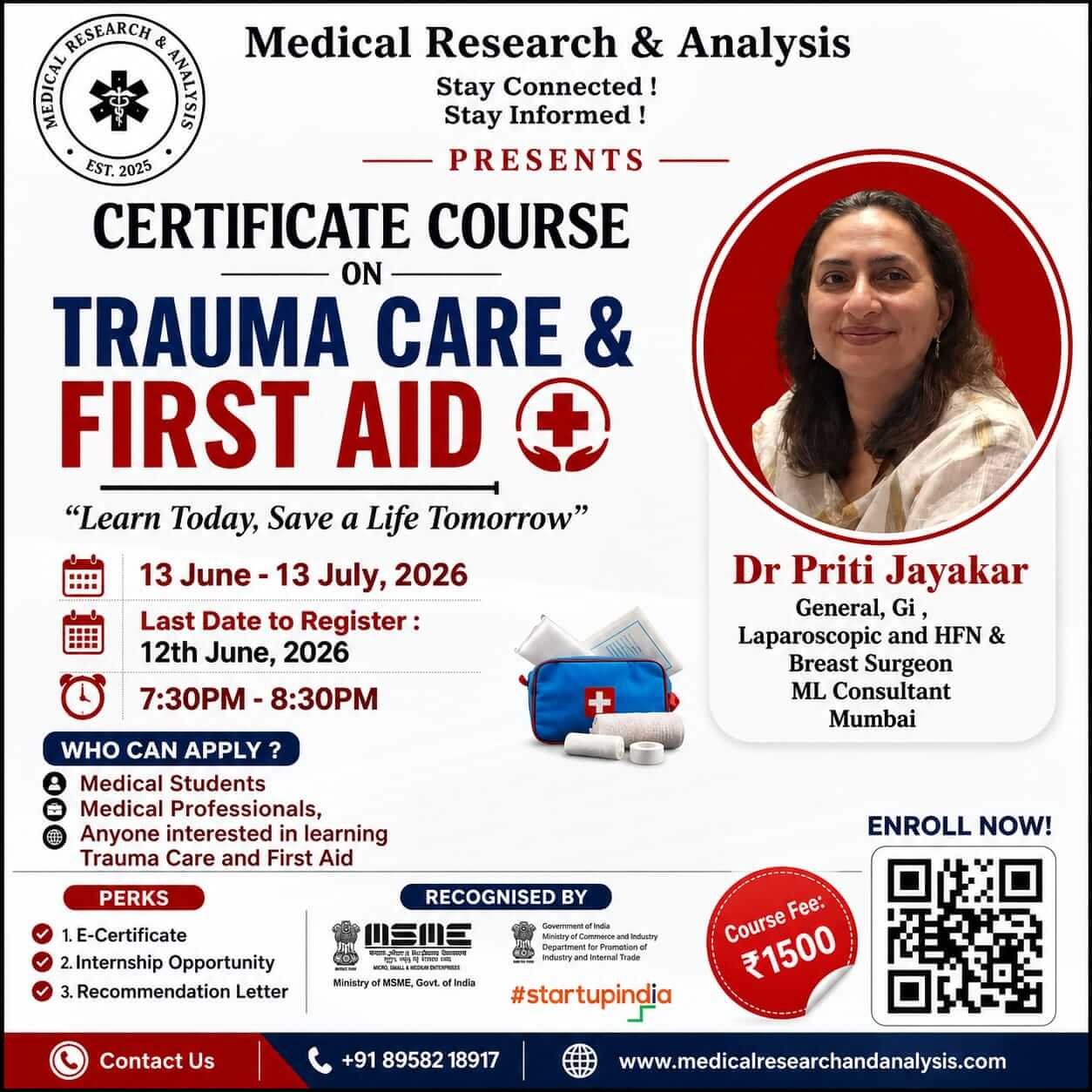
- Starts: 13th June, 2026
- Ends: 13th July, 2026
- Last date to enroll: 12th June, 2026
Course Curriculum
Week 1
Session 1: Orientation Session
Session 2: Fundamentals of Trauma & Emergency Response
- Understanding trauma and emergency situations
- Types of injuries and emergencies
- Role and responsibilities of a first responder
- Chain of survival
- Scene safety and initial assessment
Session 3: Basic Life Support (BLS) & CPR
- Understanding cardiac arrest
- ABC approach (Airway, Breathing, Circulation)
- CPR techniques (adult, child – conceptual)
- Introduction to AED (Automated External Defibrillator)
- When and how to perform CPR
Week 2
Session 4: Bleeding Control & Wound Management
- Types of bleeding (internal and external)
- Techniques to control bleeding
- Dressing and bandaging basics
- Preventing infection and complications
Session 5: Fractures, Sprains & Musculoskeletal Injuries
- Types of fractures and injuries
- Immobilization techniques
- Handling spinal injuries safely
- Safe movement and transportation of injured persons
Week 3
Session 6: Burns, Shock & Environmental Emergencies
- Types of burns and their management
- Understanding and managing shock
- Heat stroke, dehydration, and hypothermia
- Immediate response techniques
Session 7: Road Traffic Accidents & Trauma Handling
- First response at accident sites
- Scene assessment and safety
- Managing unconscious victims
- Emergency coordination and ambulance support
Week 4
Session 8: Medical Emergencies & Critical Situations
- Heart attack and stroke recognition
- Seizures and unconsciousness
- Choking and breathing emergencies
- Poisoning and allergic reactions
- Decision-making in emergencies
Session 9: Legal Aspects, Ethics & First Responder Responsibilities
- Good Samaritan Law (India)
- Legal protection while providing aid
- Ethical responsibilities in emergency care
- Do’s and Don’ts in first aid
- Accountability and safety considerations
Session 10: Concluding Session
Mentor

Dr Priti Jayakar
General, Gi, Laparoscopic and HFN & Breast Surgeon
ML Consultant
Mumbai

Dr. Hrishabh Kumar Jha
Public Health Professional, Editor-In-Chief,
Medical Research & Analysis
Career Prospects and Scope
The knowledge of trauma care and first aid is increasingly valued across multiple sectors due to its practical, life-saving nature.
- Healthcare & Medical Field – Foundation for careers in emergency medicine, nursing, and paramedical services Useful skill for hospital internships and clinical exposure Enhances readiness for real-world patient care situations
- Corporate & Workplace Safety– Roles in workplace safety and employee wellness programs Useful for HR professionals and safety officers Increasing demand for certified first responders in organizations
- Education Sector – School safety programs and student welfare initiatives Teachers trained in first aid are highly valued
- Public Service & NGOs – Community health awareness programs Disaster response and relief work Road safety and emergency awareness campaigns
- Personal & Everyday Application – Ability to respond confidently in emergencies Life-saving skills for family and community Increased awareness and responsibility
Why This Course Matters
In emergency situations, the first few minutes can save lives. This course empowers individuals with the knowledge, confidence, and skills to act when it matters most.
Contact Us
Help Desk Number: 89582 18917
Email Address: connect2mra@gmail.com